
Canvas Prints




Weave
This painting reflects on the fabric of space-time through the experience of hallucination and altered perception. My hallucinations can sometimes appear to move extremely quickly, while at other times they unfold with an unusual slowness. I have tried to capture something of that shifting rhythm through the interconnecting lines and patterns of the painting.
Although the forms may initially seem random, they suggest an underlying order that is difficult to fully comprehend. For me, the work explores the possibility that what we perceive as chaos may simply be a pattern moving beyond the limits of our senses — too fast, too slow, or too complex for us to see as a whole.
Tangled
This painting reflects the feeling of being tangled up inside my own mind. The looping lines and interwoven forms suggest thoughts that overlap and become knotted, requiring time and patience to slowly unpick. In order to process the world effectively and function well, I often need to slow down and clear my head. The work speaks to the discipline involved in that process, and to the importance of exercise, diet, mindfulness, and art as ways of restoring balance. For me, painting is part of that discipline — a way of untangling thought and finding clarity.
Jarring

This painting reflects the jarring nature of hallucination and the way perception can become disrupted in moments of stress and frustration. The tangled lines and fractured shapes suggest an experience that arrives uninvited, slowing me down and drawing me into a dissociated state. Although there is beauty within the forms and colours, that beauty is complicated by the feeling of being caught in something I did not choose. The work explores the tension between attraction and discomfort, showing hallucination as both visually compelling and deeply unsettling.

Glyphs
This painting reflects the difficulty of interpreting the world, and the way hallucinations can add an extra layer to perception. The calm blue forms suggest an underlying clarity, while the jumbled glyph-like marks move across the surface, making that clarity harder to fully see. For me, the work speaks not only about hallucination, but about the broader challenge of making sense of life — something many people struggle with for different reasons. It acknowledges that hallucinations can sometimes be interesting to experience, while also showing how they complicate perception and make it harder to see the bigger picture clearly.

Sign
This painting reflects the experience of hallucination as something that resembles language without ever becoming fully readable. The signs and glyph-like forms suggest communication, yet they do not deliver any clear message, much like hearing or seeing something that feels meaningful while remaining impossible to interpret. For me, the work explores the strange tension between the urge to decode these experiences and the recognition that they may not be saying anything at all.
At the same time, the painting speaks more broadly about the power of signs and symbols in everyday life. We live in a world saturated with language, conversation, media, and constant information. In that context, the work becomes a reflection on mental overload as much as hallucination — a space where meaning seems to gather, but clarity remains elusive.
Centre

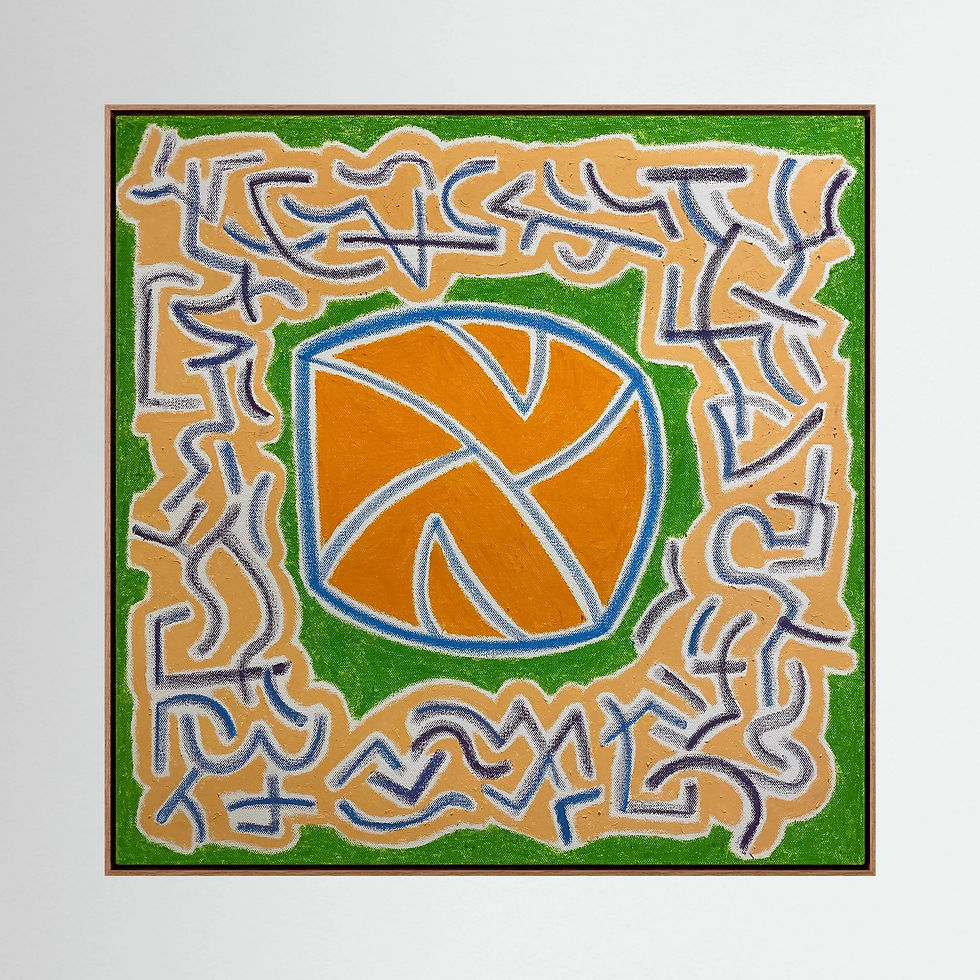
This painting presents a calm centre surrounded by chaotic, glyph-like symbols, suggesting a state of isolation within a world of noise and confusion. The central form appears enclosed by meaningless words and signs, unable to escape them, yet it remains whole and self-contained. For me, the work reflects the experience of having to hold oneself together while weathering mental and emotional pressure.
At the same time, the vivid colour at the centre gives the painting a sense of optimism and resilience. Although the outer world may feel chaotic, the inner self still carries warmth, strength, and the possibility of hope. In this way, the work becomes a reflection on endurance — on remaining intact and alive within the storm.

Void Mask
This painting reflects on the relationship between language, perception, and the unknown. The glyph-like forms move across a dark central void like a mask, suggesting the human impulse to cover emptiness with words, symbols, and thought. For me, the work explores the way language helps us make sense of the world, while also revealing its limits when faced with what cannot be fully understood.
At a deeper level, the painting considers the idea of “nothing” itself. Human beings can only think of nothingness in relation to something, and so we continually fill silence and emptiness with meaning. In this way, the work becomes a meditation on presence and absence, and on the ways we use speech, writing, and interpretation to confront what lies beyond our understanding.
HALLUCINATIONS
Hallucinations explores the uncertain boundary between perception, imagination and reality. Asemic lines and invented symbols move across the paintings like fragments of an unfamiliar language—suggesting that something is being communicated without ever becoming fully readable.
Across the series, colour, repetition and shifting patterns create a sense of movement between order and chaos. Some works feel crowded and energetic, while others contain quieter central forms surrounded by restless marks. The symbols resemble writing, yet carry no fixed meaning, leaving space for the viewer to search for their own connections.
Rather than attempting to illustrate hallucinations literally, these paintings explore what it feels like to encounter something vivid and compelling that cannot easily be explained. They reflect the human desire to find meaning in patterns, signs and experiences that may ultimately remain mysterious.